Update a gallery wall as your collection grows
Knowing how to update a gallery wall as your art collection grows should feel like editing, not rebuilding. The aim is a balanced display that still reflects your taste, while making room for new pieces and changing the rhythm of the room. Keeping a clear visual anchor helps each addition feel deliberate rather than crowded.
A larger collection often brings mismatched sizes, frames and subjects. Before rearranging, photograph the wall, note its dimensions and group the artworks by scale. Decide which pieces should remain visible, which can rotate out temporarily and which may work elsewhere in the home. This simple inventory prevents impulse hanging and gives the redesign a useful starting point.
Review the wall and collection
Start by identifying the existing strengths. A large frame, a favourite photograph or a group of related prints can act as the focal point, but choose only one dominant anchor for each wall. The rest should support it through colour, subject or scale. If the available space feels tight, leave deliberate negative space around the anchor instead of spreading small works across the entire wall.
Sort the wider collection into three groups: permanent pieces, potential additions and works in rotation. Measure each frame, including the visible mat, rather than relying on catalogue dimensions. For new works on paper, DIY framing for prints explains how to prepare artwork with suitable mats, glass and fixings before it joins the display. Reframing too early can create unnecessary expense and waste.
Plan the new composition
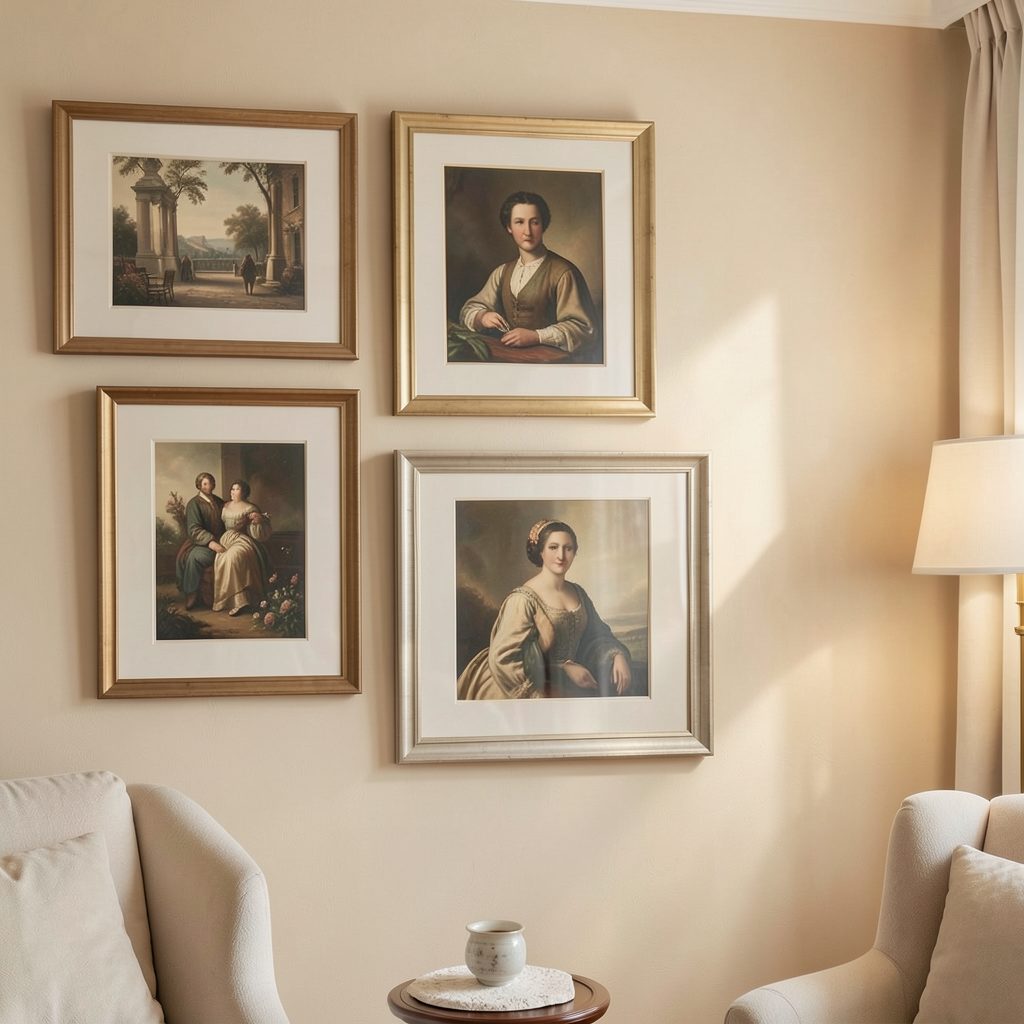
Re-create the proposed layout on the floor or a large sheet of paper. Move pieces until the eye moves naturally from the anchor to supporting works and back again. Odd-numbered groups often feel lively, while pairs can create calm symmetry, but neither rule matters more than visual balance. Keep the spacing consistent enough to establish a pattern without making every gap look identical.
Use the wall’s proportions as a guide. In a wide arrangement, distribute visual weight from left to right; in a narrow hallway, stack more vertically and keep the edges generous. Before photographing the finished arrangement for an artist portfolio, online shop or record, test the wall against the best artwork backdrops and adjust reflections or distracting colours. Digital photos can reveal spacing problems that are hard to see from across the room.
Hang the revised arrangement accurately
Mark the anchor position first, then use paper templates to transfer the outline of every frame. Check the layout from the doorway and from the main seat in the room, because visual balance changes with perspective. A laser level or long spirit level will keep the horizontal lines aligned. For furniture placement, sit before committing to the height so the artwork feels connected to the sofa, console or bed.
Choose fixings for the wall type and the weight of the work. Plasterboard needs appropriate anchors, while brick and concrete may require masonry plugs or a suitable rail. In a rental, ask the landlord before drilling and avoid relying on adhesive strips for anything heavy or valuable. If permission is limited, a leaning frame, a narrow picture ledge or one removable hanging system may offer a safer temporary solution.
Refresh frames and mats selectively
A mixed frame collection can look intentional when shape, depth or mat colour repeats elsewhere in the arrangement. You do not need to replace every mismatched frame at once. Start with the most visible pieces and consider a uniform mat colour, such as warm white, to soften differences in size. Deep frames can add weight to a minimalist wall, while thinner profiles preserve more space around small prints.
Texture, lighting and the room around the art matter just as much as the arrangement. For a gallery wall in a bedroom, bedroom styling ideas can help you coordinate the art with bedding, bedside lamps and softer textiles. Keep the display clear of pillows that create pressure points, and consider dimmable, warm lighting. A single directional picture light can add drama without introducing visible hardware across the wall.
Account for Australian conditions
Australian conditions should shape both the materials and the placement. Sydney terraces and apartments often have narrow halls, rendered brick or compact plasterboard walls, so protect the corners and check for cables before drilling. Older Melbourne homes may have uneven surfaces that need careful levelling. Brisbane’s stronger sunlight and humidity call for UV-filtering glass, stable fixings and ventilation that prevents trapped moisture from bowing frames or encouraging mould around artwork.
The local art market offers useful options beyond large gallery purchases. Melbourne’s artist-run spaces, Sydney commercial galleries, Brisbane printmakers and Adelaide’s independent makers and print sellers provide places to compare framing, paper and prices in Australian dollars. Buying directly from an artist or through a reputable gallery also supports the local creative economy. For Aboriginal and Torres Strait Islander art, source works through reputable channels, retain provenance and respect any cultural protocols attached to display, photography or reproduction.
Create an update rhythm
Treat updates as a rotation rather than a complete reset. Keep one large anchor in place while smaller works move every few months, which allows the room to stay fresh without chasing trends. When pieces leave the wall, store them upright in an archival sleeve with acid-free tissue between frames, away from direct sun and damp. Label the back of each frame with its size and hanging details for the next installation.
Record the finished arrangement with measurements, photographs and notes about the wall and fixings used. Keep spare hooks, washers and a level in a small kit so future changes are quicker and more accurate. Review the display in different daylight and at night, then adjust before adding anything new. This measured approach keeps the collection personal while giving each work enough room to be seen.
Begin with one manageable change: choose the anchor, clear a little breathing space and move a single supporting piece. Let that edit establish the direction before bringing in the rest of the collection, and resist filling every available centimetre.
Subscribe to Focus LDN for practical guidance on gallery walls, framing and stylish home living, then build a collection-led display that can change gracefully as your artwork multiplies.