Framing Children’s Artwork Like Professional Prints for a Family Wall
Children’s drawings, paintings and collages deserve more than a temporary spot on the fridge. With thoughtful editing, quality paper, and a consistent frame style, everyday school projects can become a polished family gallery wall that feels personal rather than cluttered.
The aim is not to make handmade work look sterile. A professional presentation gives each piece breathing room while preserving its colour, texture and charm. Whether your home is a compact Sydney apartment, a renovated Queenslander in Brisbane or a light-filled Melbourne terrace, the right framing decisions can make children’s artwork sit comfortably alongside the rest of your interiors.
Choosing Artwork Worth Framing
Begin by selecting pieces with a strong visual quality or a meaningful story. Look for expressive brushwork, unusual colour combinations, bold shapes and drawings that capture a particular age or interest. Three carefully chosen works will usually create a stronger display than a dozen unrelated sheets.
Create a simple rotation system rather than framing everything at once. Keep a flat archival box for favourite originals and photograph pieces before they are stored. This works especially well during Australian school holidays, when children often return home with a large collection of paintings, papier-mâché projects and classroom certificates.
Paper condition matters. Flatten curled artwork under clean books for a day or two, and avoid mounting anything that is still damp. Watercolour, crayon and felt-tip drawings can fade under Australia’s intense sunlight, so choose a wall away from direct north-facing light and consider UV-filtering glazing for treasured originals.
Creating A Professional Print Finish
A generous mat board is the simplest way to give children’s artwork a gallery-style presentation. White, warm white or soft grey creates a quiet border around vivid paint, while a pale colour sampled from the artwork can add a subtle connection. Avoid matching the mat to every shade in the picture, as this can make the frame feel overly coordinated.
Use acid-free mat board and backing where possible, particularly for works you intend to keep for years. Standard craft paper can contain acids that gradually discolour drawings. Australian framing shops, independent art suppliers and some larger retailers stock conservation materials, while custom framers in Sydney, Melbourne and Perth can cut mats to unusual sizes.
For a clean print-like effect, mount the artwork with archival photo corners or reversible tape rather than gluing it permanently to a backing sheet. A small float mount can reveal deckled edges, torn paper or raised collage details. When the surface is textured, leave enough space between the artwork and glazing so the glass does not press against it.
For further ideas on balancing objects, artwork and negative space, explore these shelf styling ideas before deciding whether the family display should be limited to a wall or extend across nearby furniture.
Planning The Family Wall
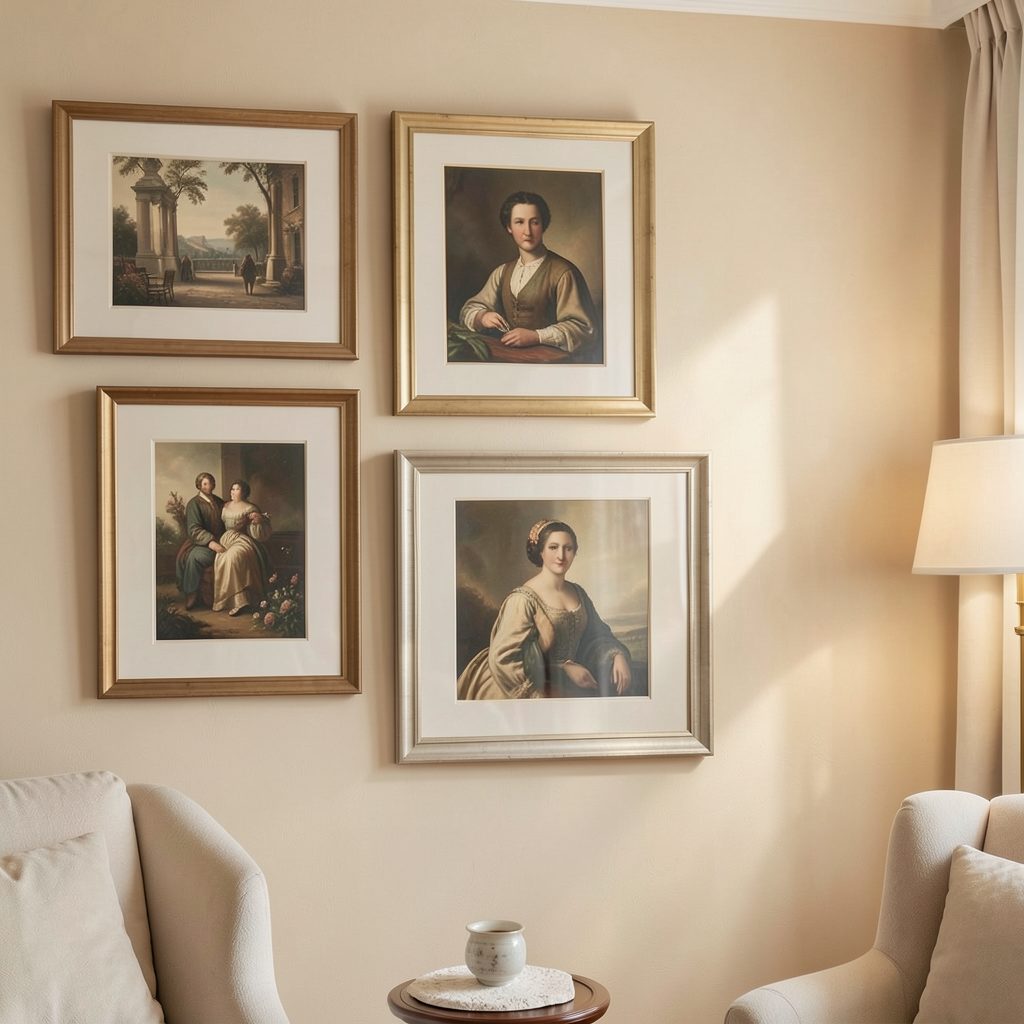
Treat the display as a composition rather than a collection of separate frames. Lay the pieces on the floor and test a few arrangements, keeping the centre of the group close to eye level for adults and children. A symmetrical grid feels calm and modern, while a salon-style arrangement suits a more eclectic home.
Frame size does not need to match the paper size. An A4 drawing can sit inside an A3 frame with a wide mat, giving it the visual weight of a professional print. For larger paintings, use simple timber or slim metal frames in black, white, oak or natural ash. Repeating one or two finishes helps the display look intentional.
Leave roughly 5–8 centimetres between frames, adjusting the gap for the size of the wall. Above a sideboard, sofa or hallway bench, keep the lower edge visually connected to the furniture rather than floating too high. In rental homes, removable hanging strips may be useful, but check their weight limits and avoid placing valuable framed work in hot, humid bathrooms.
A family wall can include small captions without becoming overly formal. A discreet title, child’s name and year can turn a drawing into a personal archive. For inspiration on presenting information beside artwork, these gallery label ideas offer ways to keep the typography restrained and elegant.
Display Checklist And Styling Notes
Before hanging, check the practical details that protect the artwork and keep the arrangement balanced.
- Choose UV-filtering acrylic or glass for pieces exposed to daylight.
- Use archival mat board for originals you want to preserve.
- Keep frame finishes consistent across the main group.
- Photograph the layout before fixing hooks or strips.
A few styling choices can make the wall feel integrated with the rest of the room.
- Echo one artwork colour in a cushion, vase or small object.
- Mix portrait and landscape orientations for a natural rhythm.
- Leave clear space around the display so it can breathe.
- Keep the most detailed piece near the centre.
Consider the room’s climate as well as its appearance. Coastal homes in places such as Adelaide, Wollongong or the Gold Coast may experience salty air or higher humidity, so avoid unsealed backing materials and check frames occasionally. In busy family areas, acrylic glazing is lighter and more impact-resistant than glass.
Keeping The Collection Fresh
Children’s interests change quickly, and a rotating gallery wall allows the room to grow with them. Keep the frame positions stable while switching one or two artworks each season. This avoids new holes in the wall and gives recently finished pieces a moment in the spotlight.
Create a small archive on a tablet or cloud folder with the child’s name, age, date and a note about the work. This record is valuable when a piece is too fragile, oversized or three-dimensional to frame. It also helps prevent the familiar problem of forgetting who made which drawing after siblings begin sharing materials.
Retail framing in Australia ranges from affordable ready-made frames at Kmart, Target and IKEA Australia to custom work from local framers and art shops. A mixed approach can work well: invest in conservation framing for a favourite original, then use coordinated ready-made frames for the surrounding pieces.
The best family gallery walls feel edited but never precious. Start with one meaningful artwork, give it a generous mat and a well-made frame, then build outward as the collection develops. Browse Focus LDN’s home styling inspiration for more ideas on creating a calm, character-filled display that belongs to your family.