Mirrors as art in a minimalist gallery layout
A mirror can do far more than reflect a room. Used with intention, it becomes a sculptural object, a source of light, and a quiet focal point within a carefully edited arrangement. Its surface changes throughout the day, giving a gallery wall movement without adding visual clutter.
Minimalist interiors benefit from this ambiguity. A framed print offers a fixed image, while a mirror responds to its surroundings: foliage appears within it, daylight shifts across its surface, and architectural details become part of the display. The result feels curated rather than overly decorated.
Using mirrors as art in a minimalist gallery layout requires the same care as selecting paintings or photographs. Scale, proportion, frame finish, placement, and the relationship between negative space and reflection all affect the final composition.
Choose a mirror with artistic presence
The most successful decorative mirrors have a distinct silhouette. Look for an arched top, an irregular outline, an aged edge, or a slim sculptural frame rather than a generic rectangular utility mirror. Simple forms can be especially effective when their proportions are unusual.
A rounded mirror softens a collection of angular prints, while a narrow vertical design can balance a low console or emphasize the height of a room. Organic shapes work well in calm interiors because they introduce contrast without competing with the restrained palette.
Consider the mirror’s visual weight before adding it to a wall. A substantial wooden or metal frame may act as the anchor for the arrangement, while a frameless mirror can function as a lighter interval between artworks.
Build the composition around reflection
Reflection should be treated as part of the artwork. Position the mirror where it captures something attractive, such as a window, a pendant light, a plant, or a layered section of the room. Avoid placing it opposite a messy storage area or a blank wall unless the simplicity is deliberate.
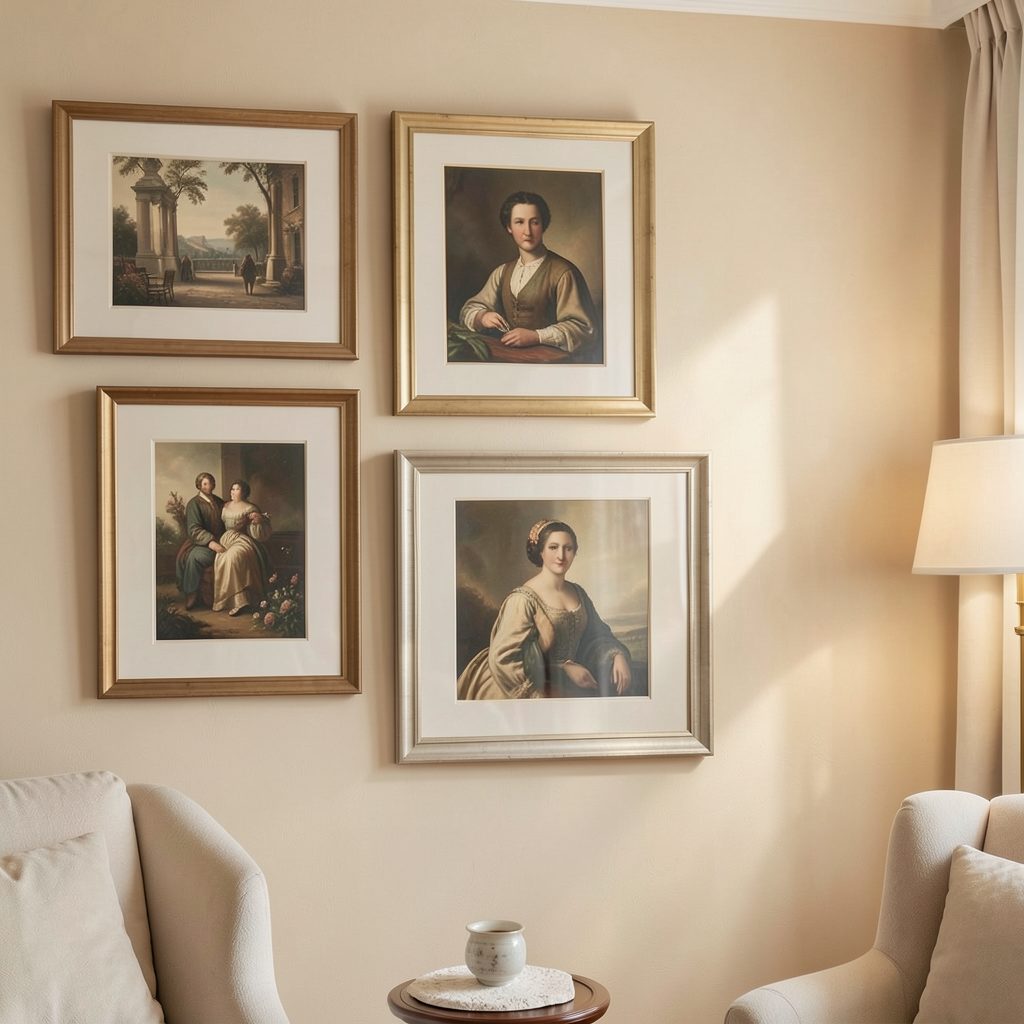
A gallery wall does not need to be perfectly symmetrical, but it should have an underlying rhythm. Pair a circular mirror with a similarly scaled print, or place a tall mirror beside several smaller works to create a balanced visual column. Repeated colors can connect different materials.
Before making holes, arrange the pieces on the floor or cut paper templates for the wall. Those who want a broader framework for spacing, sequencing, and frame selection can start an art gallery with a considered plan rather than relying on last-minute adjustments.
Match frame finishes to the room
Frame finishes determine whether the mirror feels integrated or isolated. Black metal creates a crisp, graphic outline and suits monochrome photography, architectural prints, and modern furniture. Light oak or ash brings warmth to pale walls and natural textiles.
Antique brass, aged bronze, and distressed wood introduce character, especially when the surrounding artwork includes botanical studies, vintage posters, or muted paintings. The finishes do not need to match exactly. A controlled mix often looks more collected, provided the color temperature remains consistent.
| Mirror style | Best companion artwork | Ideal visual effect |
|---|---|---|
| Rounded frameless mirror | Line drawings and soft abstracts | Airy and understated |
| Black metal arch | Photography and graphic prints | Crisp and architectural |
| Aged brass oval | Vintage artwork and botanical studies | Warm and collected |
| Sculptural irregular shape | Minimalist paintings | Expressive focal point |
| Slim rectangular mirror | Small mixed-format works | Ordered and vertical |
Use negative space as a design element
Minimalism depends on restraint, so resist the urge to fill every available section of wall. A mirror needs breathing room around its outline, especially when its frame is decorative or its shape is unusual. Empty space gives the eye time to register the reflection.
For a compact arrangement, place two or three works around the mirror instead of building a dense salon wall. The space between objects should feel intentional, with slightly tighter gaps within a group and more generous distance around the overall composition.
A large mirror can also stand alone above a sideboard or lean against a wall. In that setting, its relationship with the floor, furniture, and nearby artwork becomes the composition. Layering a small framed piece in front can create depth, but keep the overlap modest.
Adapt the idea for bathrooms and bedrooms
Mirrors are especially useful in rooms where practical and decorative needs overlap. In a bedroom, an arched mirror above a dresser can replace a conventional artwork while making the space feel larger. A pair of small mirrors beside the bed can provide symmetry without introducing bulky bedside decoration.
Bathrooms call for extra attention to scale, lighting, and moisture-resistant finishes. A decorative mirror above a basin can become the central art-like feature, while a second small piece on an adjacent wall adds continuity. For compact bathrooms without vanity space, these small bathroom art ideas can help create a polished display without making the room feel crowded.
Choose sealed frames and avoid delicate materials in areas exposed to steam. Check that the mirror reflects flattering, useful light rather than glare from a bare bulb. The best placement combines everyday function with a deliberate visual statement.
Keep the arrangement visually quiet
A refined mirror display usually has one clear focal point. If the mirror has a dramatic shape, let neighboring artwork support it through quieter colors and simpler frames. If the mirror is plain, use texture, tonal contrast, or a bold print nearby to give the composition energy.
Use these principles when editing the final arrangement:
- Select one dominant mirror and keep supporting pieces visually lighter.
- Repeat one frame color, accent tone, or geometric shape across the display.
- Leave enough wall space around the arrangement to preserve a sense of calm.
- Check the reflection from several viewpoints before fixing the hardware.
- Use warm, layered lighting so the mirror adds atmosphere rather than glare.
A final edit is often more valuable than another decorative object. Remove anything that competes with the reflection, interrupts the sightline, or makes the wall feel busy. Minimalist gallery styling works when every piece has a clear reason to be present.
Let the mirror interact with the room instead of treating it as an accessory added at the end. Choose a shape with character, frame it thoughtfully, and give its reflection a beautiful subject. Then refine the surrounding artwork until the wall feels balanced, luminous, and distinctly yours.