Black-and-White Photography for a Timeless Gallery Wall
Black-and-white photography carries a quiet drama that colour prints rarely match. Stripped of hue, every shadow, expression, and texture speaks louder, giving each image a sculptural presence. For Australians decorating apartments in Sydney, Melbourne, or Brisbane, monochrome prints offer a refined alternative to bright, trend-driven art that quickly dates.
A gallery wall built around these works moves beyond novelty into considered interior design. The format lets a curated narrative — portraits, street scenes, architectural studies — unfold across a single surface. Because the palette stays consistent, even daring compositions feel cohesive.
Climate quietly helps these displays. Compared with Brisbane's subtropical humidity or Hobart's cooler coastal air, cities like Adelaide and Melbourne enjoy relatively stable interior conditions that protect photographic paper. Couples furnishing first homes in Perth often notice that limiting colour variation also limits visual noise — a valuable trait in compact open-plan layouts.
Curating a wall of monochrome images requires more than choosing beautiful prints. Subject matter, frame weight, matting, spacing, and lighting each shape the final effect. The rest of this guide walks through each decision, drawing on local examples suited to Australian homes.
Choosing Photographs That Endure
Subject matters as much as execution. Portraits with strong emotional resonance, architectural studies of Sydney's harbourside or Melbourne's laneways, and candid street scenes tend to feel relevant for decades. Generations of Australian photographers — David Moore, Trent Parke, and others — have produced work that fits this brief, and prints surface regularly through auction houses and curated galleries in Paddington and Collingwood.
Aim for a balance of scale and intimacy. One large landscape — perhaps the Twelve Apostles at dawn or a wide Bondi view — anchors the arrangement, while smaller portraits orbit around it. Avoid mixing eras carelessly; commit to either archival heritage work or contemporary photography, letting the wall function as a coherent chapter rather than a timeline.
Selecting Frames and Materials
Frame selection transforms a casual print into a considered one. Slim matte black or brushed aluminium profiles suit modern apartments, particularly warehouse conversions in Surry Hills or Fitzroy. Tasmanian oak or spotted gum frames add warmth in coastal homes from Queensland to Western Australia.
| Frame Style | Best Suited To | Visual Weight | Maintenance |
|---|---|---|---|
| Matte black aluminium | Modern apartments, minimalist spaces | Light to medium | Low |
| Natural oak or spotted gum | Coastal and heritage homes | Medium | Moderate |
| Wide white maple | Bright, gallery-style interiors | Heavy | Moderate |
| Brass or gold-toned metal | Period features, art deco homes | High | Regular polishing |
Matting deserves attention too. A wide, acid-free white border lifts the photograph and creates breathing room, particularly useful in tight grids where elements could otherwise blur together. For renters aware of Queensland residential tenancy guidelines or NSW strata rules, lightweight framing simplifies the eventual move since adhesive strips leave walls largely intact.
Planning the Wall Layout
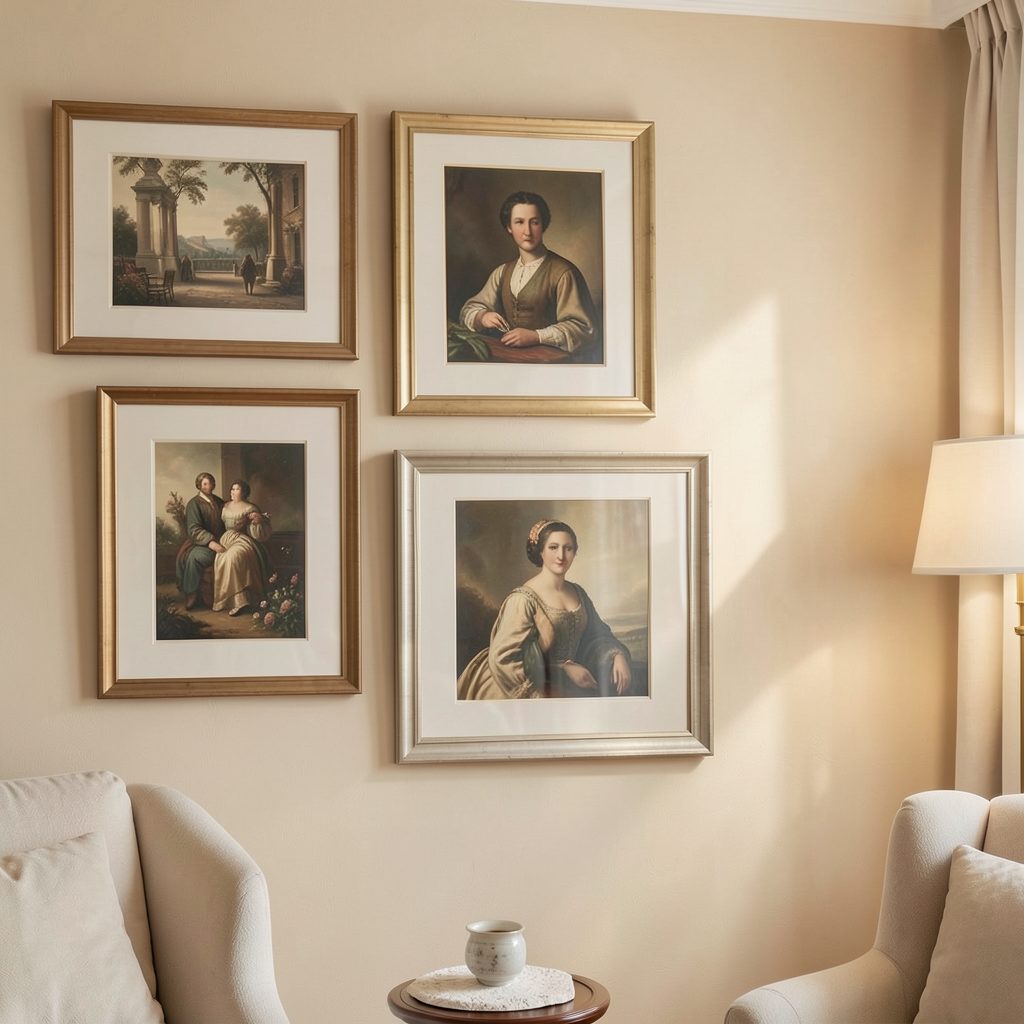
A measured layout prevents cluttered chaos. The salon-style cluster, where frames of varying sizes are linked by consistent spacing, suits spacious lounge rooms. A symmetrical grid fits better behind a low sideboard in apartments with limited floor space.
Step back frequently while hanging. Eye level for the arrangement's centre should sit roughly 145 to 155 centimetres from the floor — a guideline often used by local interior stylists. Lay frames on the floor first, trimming paper templates to match each footprint, then tape them to the wall with low-tack painter's tape. This dry run saves unnecessary nail holes.
Keep six to eight centimetres between similarly sized frames, and around ten centimetres between very different dimensions. Tighten until the layout feels balanced, then back off a little; restraint reads as confidence.
Lighting for Monochrome Imagery
Monochrome photography responds dramatically to lighting. Uplighting softens contrast and adds atmosphere; picture lights create a focused gallery feel. Many Australian homes now use warm 2700K LEDs, which complement the tonal range without bleaching subtle mid-tones.
Positioning matters. Avoid harsh afternoon western sun in Perth or Brisbane, which fades emulsions even behind UV glass. A north or south wall — common in Melbourne's Victorian terraces and Sydney's east-facing apartments — provides the most stable ambient conditions.
Battery-operated picture lights suit renters who cannot hardwire fixtures. Local retailers including Domayne and Temple & Webster stock dimmable options that pair with smart home systems. One statement pendant above the arrangement can also pull attention to the wall from across the room.
Styling Around the Display
A slim console below the wall can hold a small stack of photography monographs — perhaps a Moriyama collection or an Australian publication from T&G Publishing — keeping the theme alive without competing for attention.
If you are working with the angles of a converted warehouse or loft apartment, this guide on decorating a loft explores similar challenges with high ceilings and exposed brick.
Plants soften the linear formality. A potted olive or fiddle-leaf fig introduces organic shape, especially in sun-filled Brisbane rooms. Avoid clustering decor directly beneath the gallery; the wall deserves room to breathe.
Hanging and Long-Term Care
Match hardware to frame weight. Two-prong hooks suit frames up to about eight kilograms; heavier pieces need wall anchors or studs. In homes built before 1990, particularly in Adelaide and inner Sydney, walls may be solid brick — use masonry plugs. Plasterboard construction, common in newer Brisbane developments, demands hollow-wall anchors instead.
Dust frames monthly with a soft microfibre cloth. Never spray cleaning products directly onto glass or perspex; the liquid can seep under the rebate and damage the print. If a print begins to curl at the edges, take it to a professional framer rather than attempting repairs yourself.
Monitor for foxing — small brown spots that signal humidity damage. This is especially relevant in coastal homes near the Coral Coast or in tropical Queensland apartments where air conditioning reduces but does not eliminate moisture. A simple dehumidifier protects the entire wall, not just individual pieces.
Practical Recommendations for a Lasting Gallery Wall
- Source prints from archival collections or recognised Australian photographers
- Stick to one frame family — either all black, all timber, or all brass
- Use wide white matting to give each image breathing space
- Hang the arrangement's centre 145 to 155 centimetres above the floor
- Choose UV-protective glazing for any wall in direct sun
- Lay out templates on the floor before committing to nails
- Add one organic element nearby — a plant, a ceramic vessel — to soften the formality
Build a wall that lasts, explore more curated home styling at Focus LDN, and join the email community for ongoing guidance on refined apartment living across Australia.